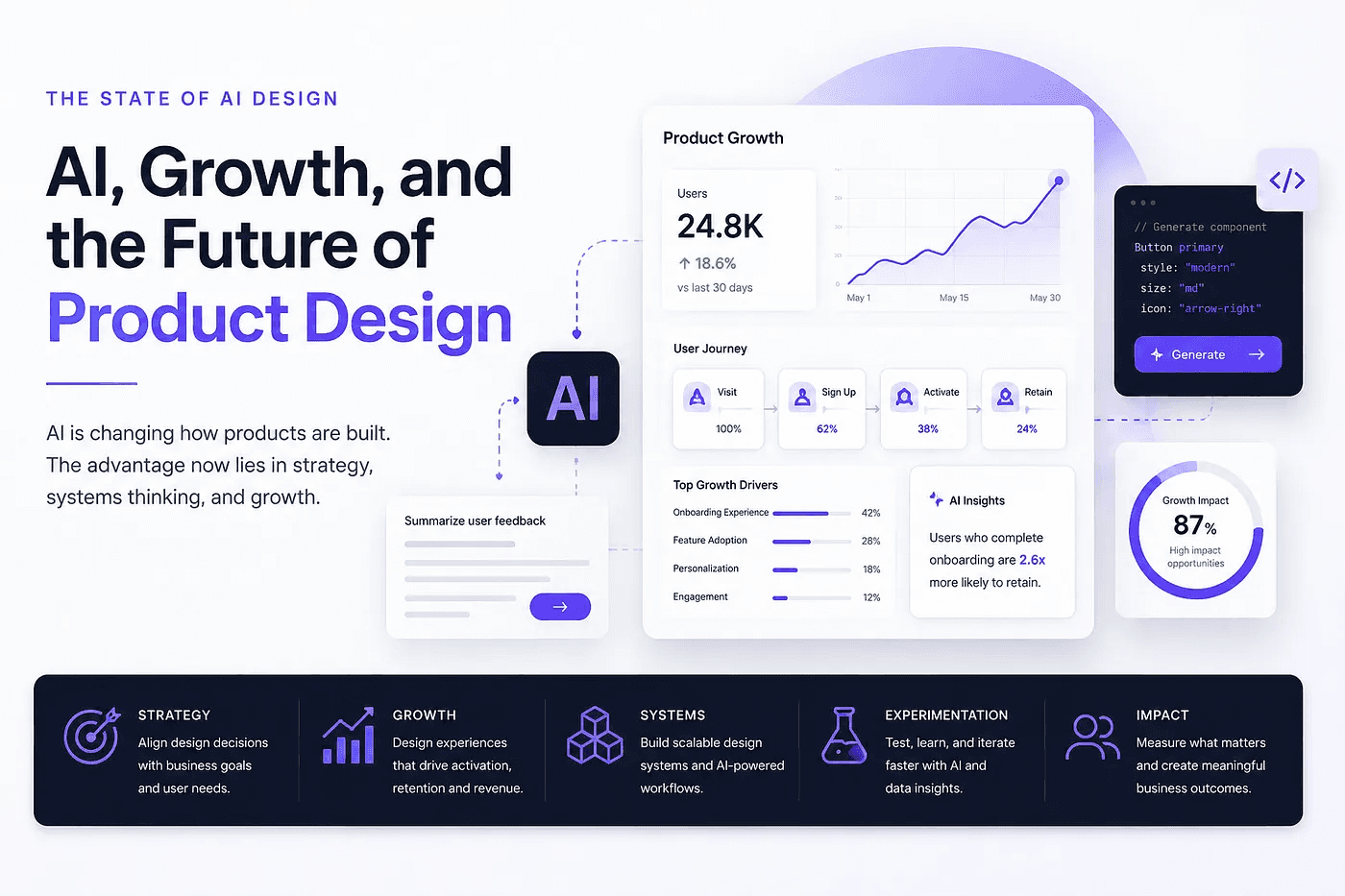
Why the future of design belongs to strategists, systems thinkers, and AI-native product builders
The latest State of AI in Design report confirms a major shift: AI is no longer just a productivity tool. It is becoming part of the product development operating system.
For years, design focused on interfaces, user flows, and visual systems. Today, AI can generate many of those outputs in seconds. As execution becomes easier, strategy becomes more valuable.
The question is no longer:
“Which AI tool should I use?”
It’s:
“How do I build workflows where AI becomes part of the entire product lifecycle?”
From Tools to Systems
Designers now work with AI copilots, coding assistants, research tools, automation platforms, and rapid prototyping systems.
The real advantage does not come from using these tools individually. It comes from connecting them into scalable workflows.
Leading companies are not just adding AI features. They are redesigning how products are built.
Companies like Perplexity, Anthropic, Notion, Linear, and Duolingo share a common pattern: they use AI to improve outcomes, not simply increase productivity.
The shift is clear. AI is moving from a collection of tools to an integrated part of how products are designed, built, tested, and optimized.
Why Growth Design Matters More Than Ever
As AI reduces the effort required to create screens, product teams are focusing on what drives business value:
Activation
Retention
Conversion
Engagement
Revenue
This is why Growth Design and UX Strategy are becoming critical skills.
Future designers will be measured less by outputs and more by outcomes. The ability to understand user behavior, identify friction points, and influence business metrics is becoming a key differentiator.
Creating interfaces is becoming easier. Creating impact is not.
Designing Adaptive Experiences
Traditional UX relied on static journeys. Every user moved through the same onboarding flow, navigation structure, and experience.
AI changes that model.
Products can now adapt in real time based on user intent, behavior, context, and preferences.
Designers are no longer creating a single user flow. They are designing systems that can generate personalized experiences at scale.
The challenge is shifting from interface design to decision design.
The products that win in the AI era will not be the ones with the most features. They will be the ones that best adapt to individual user needs.
The Rise of the Strategic Product Designer
As AI takes on more execution work, the role of the designer expands.
The next generation of designers will combine:
Product Thinking
UX Strategy
Growth Optimization
Systems Design
Data-Informed Decision Making
AI-Native Workflows
These skills sit closer to business strategy than traditional design execution.
The most valuable designers will not be those who can create screens the fastest. They will be those who can connect user needs, business goals, and emerging technologies into scalable product systems.
Final Thought
AI is not replacing designers. It is raising the value of what designers do best.
As execution becomes automated, skills like strategy, systems thinking, product judgment, creativity, and understanding human behavior become even more important.
The future is bright for designers who embrace AI and evolve with it.
This is not the end of design. It is the beginning of a bigger role.
References
This article is inspired by insights from the State of AI Design 2026 report, based on research with hundreds of designers and design leaders exploring how AI is transforming the future of product development.
Read the full report:

